Law & Tax
From Parlays to Single Games: How Canada Legalised Single-Event Betting
For decades a legal sports bet in Canada had to combine several games. A private member's bill changed one paragraph of the Criminal Code in 2021
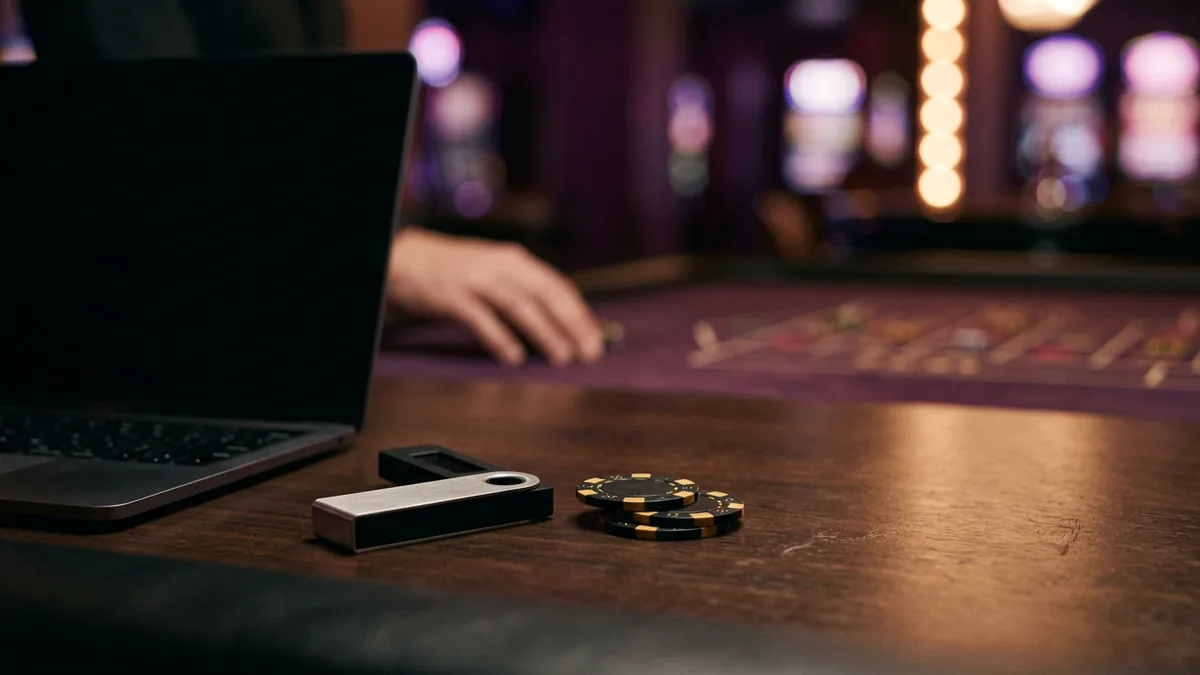
Paying a casino in bitcoin feels like spending money. For the CRA it is a disposition of property, with a gain or loss measured in Canadian dollars every time coins leave or come back to you. The jackpot can be tax-free while the coins around it are not.
Recreational gambling winnings are generally not taxed in Canada; we explain why in our main guide to gambling winnings and tax. Crypto players often stop reading there. The problem is that a crypto casino session involves two separate things for tax purposes: the bet, and the property you bet with.
The Canada Revenue Agency (CRA) treats crypto-assets as property, not money. Moving that property to a casino, and receiving it back, are events the CRA expects you to value in Canadian dollars. This article sets out how that works, with worked examples in C$.
Think of a crypto casino session as two ledgers running side by side.
The CRA makes the link explicit. Its page on understanding crypto-assets and tax obligations contains a table of transactions where you must determine the value of your crypto-assets. Under both acquisition and disposition, the table lists gambling, alongside selling, trading, barter, gifts and donations.
According to the CRA's guidance on reporting income from crypto-asset transactions, you dispose of a crypto-asset when you trade or exchange it for government-issued currency or another crypto-asset, use it to buy goods or services, or transfer it by gift or donation. Paying with crypto is treated as a barter transaction. By contrast, transfers between wallets that you own generally do not result in a taxable disposition.
A casino deposit address is not your wallet. When you send coins to it, they leave your ownership in exchange for a casino balance, and the CRA's table puts that under disposition. When the casino pays you back in crypto, you acquire new coins, and their cost to you is their fair market value at that moment.
Most players will be on the capital side. The CRA says that if a crypto-asset transaction is not made on account of business income, it is considered capital in nature. You then include half of the capital gain in income, and allowable capital losses, also half, can only be used against taxable capital gains. Net capital losses can be carried back three years or forward indefinitely.
The CRA lists factors that point to business income instead: a history of extensive buying and selling, holding crypto for short periods and turning it over quickly, knowledge of crypto markets, time spent studying them, financing purchases with debt and advertising a willingness to buy. Even an isolated transaction can be business income if it is an adventure or concern in the nature of trade. Business income is fully taxable. Someone who constantly flips tokens between exchanges and casino wallets to chase price moves should take that list seriously.
Your gain or loss is proceeds minus adjusted cost base (ACB). The CRA describes ACB as usually the cost of a crypto-asset plus expenses to acquire it, and in its tax tip on capital gains it says ACB is usually the weighted average cost of a crypto-asset. In practice, when you buy the same coin several times at different prices, you average the cost across all units you hold.
| Purchase | Units of coin X | Cost incl. fees |
|---|---|---|
| March purchase | 0.03 | C$2,700 |
| June purchase | 0.02 | C$2,300 |
| Total | 0.05 | C$5,000 |
| Average cost per whole unit | C$5,000 / 0.05 | C$100,000 |
Selling or spending some units does not change the per-unit average of what remains; a new purchase does.
Using the holdings above, suppose you send 0.02 units to a casino when the market value is C$120,000 per unit. You play, win, and withdraw 0.03 units when the price is still C$120,000. Two weeks later you sell those 0.03 units on an exchange at C$125,000 per unit.
| Step | Calculation | Result |
|---|---|---|
| Deposit 0.02 units (disposition) | Proceeds 0.02 x C$120,000 = C$2,400; ACB 0.02 x C$100,000 = C$2,000 | Capital gain C$400 |
| Casino winnings | Recreational play: windfall | Not taxed |
| Withdraw 0.03 units (acquisition) | Fair market value 0.03 x C$120,000 | New cost C$3,600 |
| Sell 0.03 units for CAD (disposition) | Proceeds C$3,750 minus cost C$3,600 | Capital gain C$150 |
| Total capital gains | C$400 + C$150 | C$550 |
| Taxable at one-half | C$550 x 50% | C$275 added to income |
Notice that the C$1,200 of value you won at the tables never appears as income. What appears is the price movement of the coins while you held them. For simplicity this example adds the 0.03 withdrawn units as a separate holding; strictly, if you still hold other units of the same coin, the new units go into the same weighted average.
Now suppose you deposit the same 0.02 units at C$120,000 and lose all of it. You still disposed of the coins at fair market value, so the C$400 capital gain from Example 2 stands, and the C$2,400 gambling loss is not deductible. Many players are surprised by this: a losing night can still produce a taxable gain if the coins had risen in value since purchase.
The reverse also holds. If you bought coins at C$100,000 per unit and deposited them when the price had fallen to C$80,000, the deposit realises a capital loss of the difference, which can be applied against taxable capital gains.
Some players use a dollar-pegged token to avoid volatility. That reduces the size of gains, but it does not remove the disposition. The token is still property valued in Canadian dollars, and its value moves with the exchange rate between the US dollar and the Canadian dollar if it is pegged to the US dollar. If a casino cashier converts one crypto-asset into another for you, that is a crypto-for-crypto trade. The CRA's own worked example measures such a trade as the fair market value of what you received minus the ACB of what you gave up.
The CRA's page on determining the value of crypto-assets says it generally accepts fair market value for tax reporting. You must use a reasonable method, apply the same method every year and keep a record of how you calculated values. The page gives two examples of methods: using the rate from the exchange broker you use, or averaging high, low, open and close values across several high-volume brokers. Casino cashier screens often show a conversion, but a screenshot of a casino rate is weaker evidence than a consistent method you apply to every transaction.
The CRA's page on keeping books and records of crypto-assets lists what to keep for each transaction:
For exchanges and custodial platforms, keep trade and transfer ledgers and export your activity history regularly. Records must be kept for at least six years from the end of the last tax year to which they relate. A casino account history showing deposit and withdrawal transaction IDs is worth saving alongside your wallet records, because it links the coins that left your wallet to the coins that came back.
In Ontario, the AGCO's Registrar's Standards for Internet Gaming state in standard 5.69 that cryptocurrency is not legal tender and shall not be accepted for deposits. Crypto casinos that Canadians find online are therefore typically operating outside Ontario's regulated market, and other provinces run their own lottery-corporation sites. That affects your recourse if a withdrawal stalls; see why casino withdrawals sit pending. If you are weighing payment options generally, our overview of casino payment methods and the dedicated bitcoin casino page cover the trade-offs.
The windfall rule protects the win, not the coins. Every deposit to a casino is a disposition at fair market value, every crypto withdrawal is an acquisition at fair market value, and every later sale or swap is another disposition. Track a weighted average cost, value each event in Canadian dollars with a consistent method, and keep six years of records. Players must be of legal gambling age in their province (18+ or 19+). This article explains published CRA guidance and is not personal tax advice; if your activity looks like trading, speak with a tax professional.
It is a disposition. The CRA lists gambling among crypto-asset dispositions, so you compare the coins' fair market value at deposit with your adjusted cost base and report any capital gain or loss.
For recreational players, gambling winnings are windfalls and are not taxed. The coins you receive take a cost equal to their fair market value when you receive them, which matters when you later sell them.
Half. The CRA says you include half of a capital gain in income, and allowable capital losses can only be used against taxable capital gains.
The CRA says at least six years from the end of the last tax year to which the records relate.
The AGCO's Registrar's Standards for Internet Gaming say cryptocurrency is not legal tender and shall not be accepted for deposits.
How we rateWe may earn a commission from partner links; it does not change what we write.19+ (18+ AB, MB, QC)Help: ConnexOntario 1-866-531-2600
For decades a legal sports bet in Canada had to combine several games. A private member's bill changed one paragraph of the Criminal Code in 2021

Canada has no single gambling age. Three provinces set it at 18 and the rest of the country at 19, with a few product-level exceptions, and the rule

A wagering requirement tells you how much must be staked. The game contribution table, usually further down the terms, decides how much of each bet